
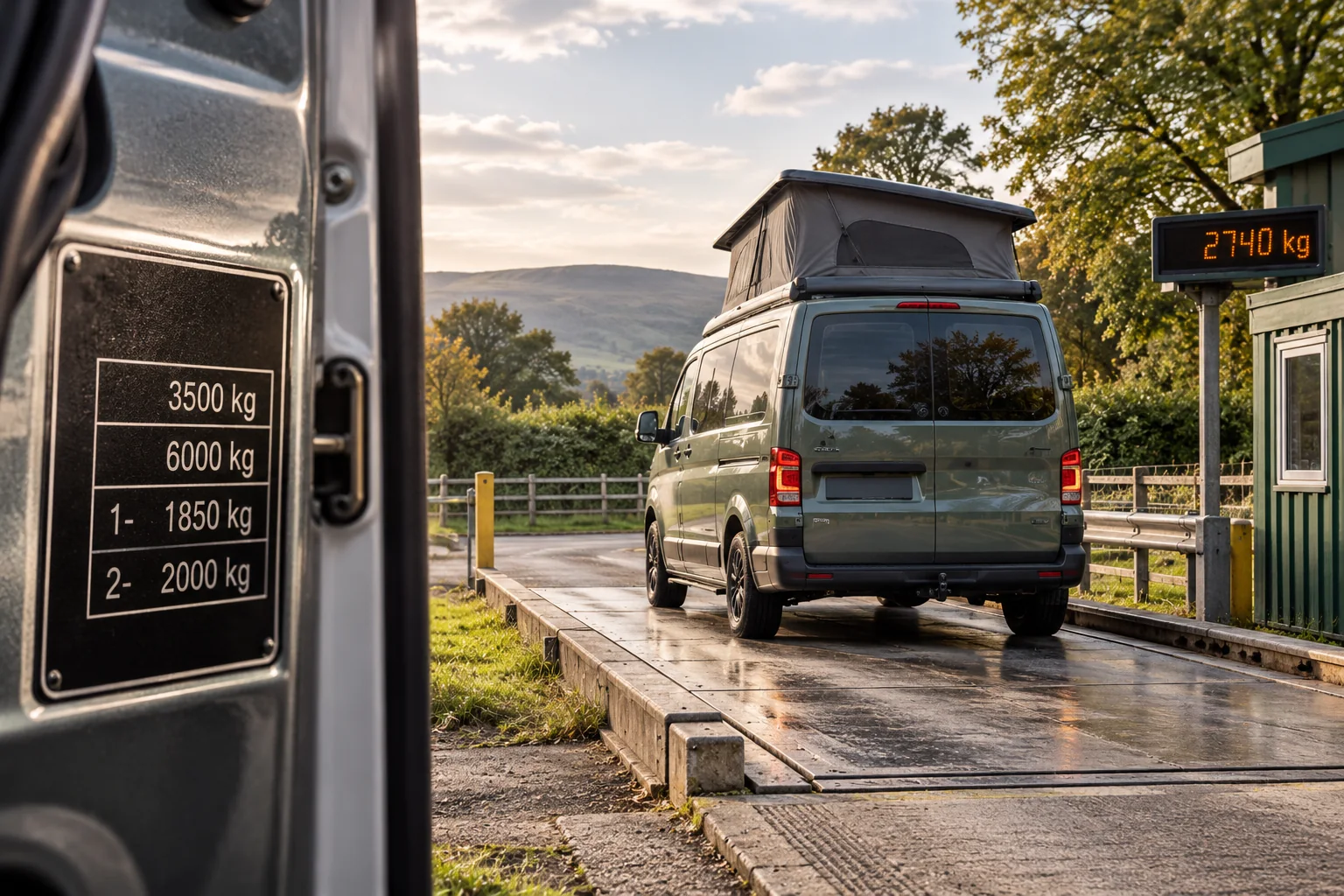
Payload is one of the least exciting parts of campervan ownership — until it becomes important.
Every campervan has a maximum permitted weight. Everything you add to the vehicle uses some of that allowance: passengers, water, fuel, food, clothes, bikes, accessories and all the useful things that gradually find their way into cupboards.
The problem is that a campervan can look perfectly normal and still be overweight.
What does payload mean?
In simple terms:
Payload is the amount of weight you can add to the vehicle before reaching its maximum permitted weight.
That includes people as well as possessions.
The vehicle’s maximum permitted loaded weight is usually referred to as its Maximum Authorised Mass (MAM) or maximum gross weight.
You can normally find this figure on the vehicle’s weight plate or identification plate.
A simple example
Imagine a campervan has:
- Maximum Authorised Mass: 3,500kg
- Actual ready-to-travel weight before passengers and luggage: 3,050kg
That leaves:
450kg of available payload.
That 450kg then has to cover everything else you put in the vehicle.
Two adults, water, bikes and luggage can use a surprisingly large amount of it.
What counts towards payload?
Almost everything added to the vehicle contributes towards its weight.
This can include:
- driver and passengers
- fresh water
- waste water
- fuel
- gas bottles
- food and drink
- clothes and bedding
- bikes
- outdoor furniture
- cooking equipment
- tools
- electrical equipment
- permanently fitted accessories added after manufacture
Even small items matter because there may be a lot of them.
Water is heavier than it looks
One litre of water weighs approximately one kilogram.
So carrying 100 litres of fresh water adds roughly 100kg to the vehicle.
That does not mean you should never travel with a full water tank. It simply means that water is part of the payload calculation rather than free storage space.
Depending on where you are travelling and where you can refill, carrying less water may release useful payload.
Accessories can quietly reduce payload
Payload can also be reduced by equipment added to the campervan.
Examples might include:
- awnings
- bike racks
- solar panels
- additional batteries
- air conditioning
- satellite equipment
- tow bars
Some of these may already be included in the vehicle’s stated weight, depending on how and when it was fitted.
If in doubt, weigh the actual vehicle rather than relying on assumptions.
The number that matters is the real weight
Brochures and specifications are useful starting points, but the most reliable way to understand your available payload is to weigh the vehicle in the condition in which you actually use it.
A public weighbridge can give you the vehicle’s actual weight.
Ideally, weigh it in realistic touring condition:
- normal fuel level
- usual water load
- gas bottles
- passengers if practical
- typical luggage
- bikes and regular equipment
The closer the weighing setup is to a real trip, the more useful the result.
Axle weights matter too
Staying below the vehicle’s overall maximum weight is not the whole story.
The front and rear axles also have maximum permitted loads.
A campervan can therefore be within its total weight limit but still have too much weight over one axle.
This is particularly relevant when carrying heavy items at the rear, such as bikes or equipment in a garage area.
Where possible, use a weighbridge that can provide individual axle weights as well as the total.
Driving licence limits
Your driving licence also matters.
In Great Britain, a standard Category B driving licence generally allows you to drive vehicles with a Maximum Authorised Mass of up to 3,500kg.
Vehicles above 3,500kg may require additional licence entitlement, such as Category C1.
Check your own licence rather than assuming entitlement based on age or when you passed your test.
How to find a public weighbridge
GOV.UK provides a public weighbridge finder.
What to do if your payload is tight
Start with the easiest weight to remove.
Look at:
- excess water
- duplicate cooking equipment
- tools you rarely use
- unused outdoor furniture
- unnecessary food and drink
- spare clothing
- accessories that never earn their space
This is where the TouringSmarter principle of carrying less becomes practical rather than cosmetic.
If something adds weight but rarely solves a real problem, question whether it needs to live permanently in the van.
Do not guess
If payload is close, weighing the vehicle is better than estimating.
Campervan specifications, optional extras and conversions vary too much to rely on general assumptions.
The important numbers are:
- your vehicle’s actual weight
- its Maximum Authorised Mass
- its axle limits
- your driving licence entitlement
Once you know those, payload becomes straightforward arithmetic rather than guesswork.
The TouringSmarter rule
Know the vehicle’s real weight before deciding what else it can carry.
Then make every permanent item justify the space and weight it uses.
How this guide was prepared
This guide uses general UK vehicle-weight and driving-licence information from official sources. Vehicle specifications and licence entitlements vary, so check the actual vehicle plate, your driving licence and current GOV.UK guidance before relying on the figures for a specific campervan.