
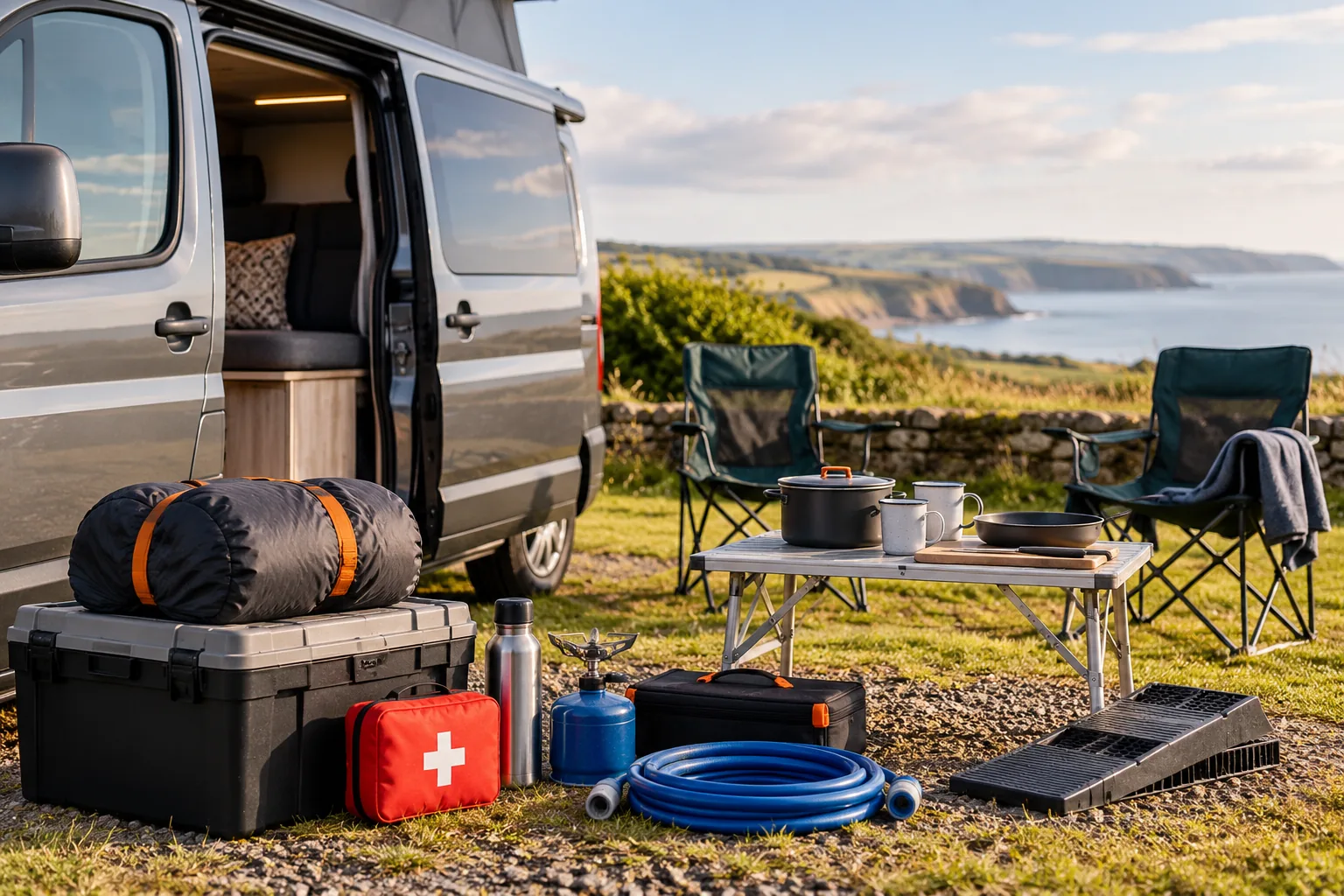
You don’t need to fill your campervan with gadgets to enjoy touring. Here’s what deserves space, what depends on how you travel, and what you can probably leave at home.
The quick answer
Start with safety, sleeping, water, cooking and the equipment your particular campervan needs to operate. Add convenience items only when they solve a problem you’ve actually experienced.
Our approach is simple:
- Worth carrying: Essential or consistently useful equipment.
- Depends how you tour: Useful in the right circumstances, but not for everyone.
- Probably leave it at home: Items that take up space without earning their place.
A campervan is not a smaller house. It’s a vehicle where every kilogram and every cupboard matters.
Buying disclosure: TouringSmarter may earn a small commission from clearly identified affiliate links, at no additional cost to you. Recommendations are based on usefulness and evidence, not commission. This guide is researched using trusted sources; it is not a claim that TouringSmarter has personally tested every item.
Worth carrying: the basics
1. Safety and emergency essentials
Before buying anything clever for your campervan, deal with the basics.
Carry a suitable first aid kit, any essential medication, a working torch, and the safety equipment appropriate to your vehicle and trip. A suitable fire extinguisher and fire blanket are sensible additions; make sure you know how and when to use them.
Check your vehicle’s handbook and maintain any fitted safety systems, including smoke and carbon monoxide alarms where applicable.
You should also have a practical means of contacting breakdown assistance and know where your vehicle documents and emergency information are kept.
TouringSmarter view: Safety equipment isn’t where we’d look to save a little space or money.
2. Water and waste equipment
A food-safe drinking-water hose or suitable container, plus equipment for handling waste water, can make campsite visits considerably easier.
Not every van needs the same equipment. Some have onboard tanks, others use portable containers, and some rely heavily on campsite facilities.
Buy what suits your actual arrangement.
A compact hose that stores cleanly is generally more useful than carrying a large assortment of fittings you never use.
Before buying: Check how your van’s water system is filled and emptied. Don’t assume another owner’s equipment will fit yours.
3. A simple cooking kit
You can cook surprisingly well with very little.
For most touring, start with:
- One saucepan and one frying pan, if you use both.
- A sharp knife and compact chopping board.
- Enough plates, mugs and cutlery for the people travelling.
- A kettle or whatever you genuinely use to make hot drinks.
- A small washing-up kit.
Choose items that fit the cupboards and equipment you already have.
If your campervan has a working hob, buying another portable cooker may add complexity rather than convenience.
TouringSmarter view: Pack for the meals you’ll actually cook, not the meals you imagine cooking on holiday.
4. Comfortable bedding
A decent night’s sleep matters more than many accessories.
Choose bedding that suits the temperature, sleeping arrangement and storage available. You may prefer a duvet, sleeping bags or compact alternatives.
Check what fits your bed and where you’ll store it during the day.
The aim is comfort without turning the van into a travelling linen cupboard.
5. A small set of everyday essentials
A few ordinary items repeatedly earn their place:
- Toilet paper and appropriate cleaning supplies.
- Rubbish bags.
- Microfibre cloths and a small brush.
- A compact phone-charging arrangement.
- Weatherproof clothing and appropriate footwear.
- A small selection of basic tools appropriate to the vehicle.
Many of these cost little and solve real problems.
TouringSmarter view: The best campervan accessory is often something ordinary, compact and used regularly.
Depends how you tour
These items can be excellent purchases. They can also be unnecessary weight.
| Item | Worth considering when | Think twice when |
|---|---|---|
| Camping chairs | You regularly sit outside | Your trips involve frequent moves and little outdoor sitting |
| Outdoor table | You often eat outside | Campsites have facilities or you rarely use one |
| Levelling ramps | Your van and chosen pitches genuinely need them | You haven’t established a need |
| Electric hook-up cable | Your van supports hook-up and you book pitches offering it | You use a different power arrangement |
| Portable power station | You have a defined electrical requirement | You haven’t calculated what you need to power |
| Extra storage boxes | They fit unused spaces and make access easier | They merely encourage you to carry more |
| Portable barbecue | Outdoor cooking is part of how you tour and site rules allow it | It only comes out once a year |
What about levelling ramps?
Some pitches are uneven, and a suitable set of ramps can make an uncomfortable stop much better.
But you need ramps rated and suitable for your vehicle, and you must follow the manufacturer’s instructions. They’re not a substitute for safe parking.
Do you need a portable power station?
Possibly, but not automatically.
First establish what equipment you want to use, how much power it needs, and how you will recharge the unit.
If you already have adequate leisure-battery capacity, hook-up facilities and USB charging, an additional power station may solve a problem you don’t have.
Don’t buy a battery because someone else’s campervan has one.
Should you carry outdoor furniture?
Only if you use it.
A chair that comes out at every stop deserves its space. A bulky furniture set that stays in the garage or van cupboard does not.
Choose compact, robust equipment over unnecessary features.
Probably leave it at home
It’s easy to buy gear that looks useful in a video or at an exhibition but has limited value once you’re touring.
Think carefully before packing:
- Duplicate cooking appliances.
- Full sets of household crockery.
- Large quantities of spare clothing.
- Heavy, single-purpose kitchen gadgets.
- Multiple chairs or tables that rarely get used.
- Large tool collections beyond your practical needs and competence.
- Decorative accessories that take up valuable storage.
- Equipment bought for hypothetical emergencies rather than a sensible risk assessment.
That doesn’t mean these things are always wrong. It means they should earn their place.
Weight matters as much as space
Your campervan has a maximum permitted loaded weight and axle weight limits. Both matter.
The weight of passengers, water, fuel, equipment, accessories and belongings can all affect how much capacity you have available.
Manufacturer figures for running weight may include different allowances, so don’t assume the advertised payload is exactly what you can carry.
The reliable approach is to weigh your van in normal touring condition, including passengers and equipment, using a suitable weighbridge. Check the individual axle loads as well as the total.
Heavy equipment should be stored securely, with its position considered in relation to the vehicle manufacturer’s loading instructions. Loose items must not become hazards when braking.
A little space in a cupboard doesn’t automatically mean you have the weight allowance to fill it.
How to decide whether something deserves a place
Before buying, ask five questions:
- What problem does it solve? Can you describe a real inconvenience?
- How often will I use it? Every trip, occasionally or perhaps never?
- Where will it live? Does it have a sensible, secure storage place?
- What does it weigh? Is it worth using some of your available payload?
- Do I already own something that does the job? Could that work instead?
If the answers aren’t convincing, don’t buy it yet.
This simple test is more useful than most lists of must-have campervan gadgets.
TouringSmarter’s recommendation
Start with a modest kit. Tour for a few weekends. Then make changes based on what actually happens.
Keep three mental lists: things you used, things you wished you’d brought and things that never left the cupboard.
The aim isn’t to own the lightest or most minimal campervan. It’s to have a comfortable, safe and practical van that suits the way you travel.
Less stuff. Better touring.
What to do next
Before your next trip, take ten minutes to inspect your equipment. Remove anything that hasn’t earned its place, check your safety essentials, and write down the one or two items that would genuinely improve your touring.
If you’re setting up a new van, concentrate on getting the basics right before shopping for accessories.
Related TouringSmarter guides
- Campervan essentials: what you really need before your first trip.
- Campervan payload explained: how much weight can you actually carry?
- Campervan storage: how to make a small space work harder.
Further reading
- The Camping and Caravanning Club: Camping safety, including carbon monoxide and fire safety.
- The Camping and Caravanning Club: Motorhome safety on the road, including payload and loading.
Reviewed: 8 October 2026. This article provides general UK campervan guidance. Check your vehicle handbook, equipment instructions and relevant safety requirements before use.