
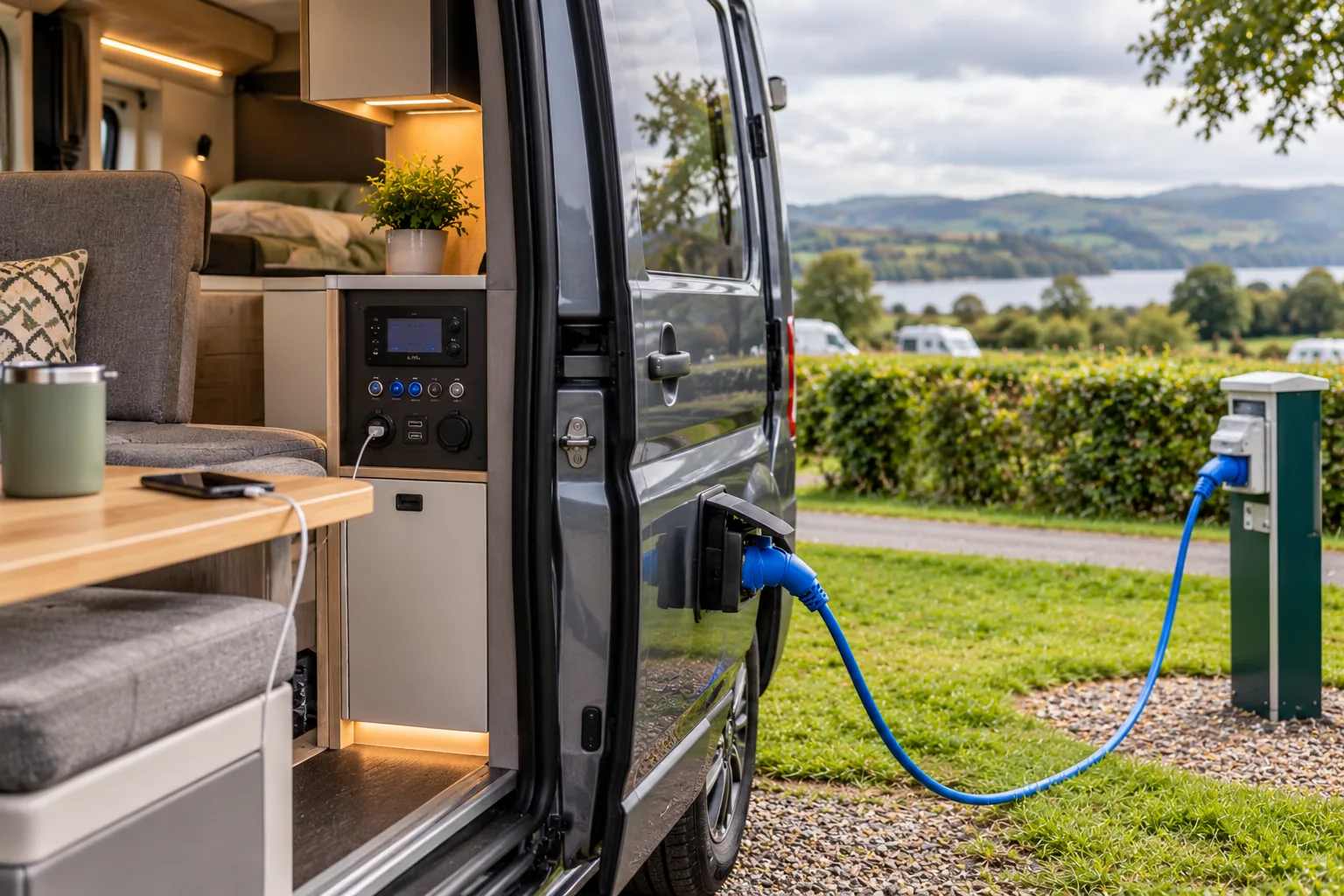
Leisure batteries, electric hook-up, solar panels and inverters can make campervan electrics sound complicated. The basics are easier to understand once you know what each part does.
You don’t need to be an electrician to enjoy a campervan. But knowing where its electricity comes from, what it can power and how it gets recharged makes touring much easier.
The important thing is to understand your own vehicle rather than assuming every campervan works the same way.
The quick answer: Most campervans use a leisure battery to supply 12V equipment. Electric hook-up provides a 230V mains supply when connected to a suitable campsite point. Charging systems replenish the leisure battery, while an inverter can provide mains-style power from a battery if one is fitted.
Exactly what works, and for how long, depends on your installation.
1. The two types of electricity in a campervan
The simplest way to understand campervan electrics is to separate the two main systems.
12V: the everyday campervan supply
The leisure battery normally supplies low-voltage equipment in the living area.
Depending on your vehicle, this can include:
- Interior lighting.
- Water pumps.
- USB charging outlets.
- Ventilation fans.
- Some fridges and heating controls.
- Other equipment specifically designed for the vehicle’s 12V system.
These devices can often operate without a campsite electric hook-up, provided the leisure battery has sufficient charge.
Not every system operates in exactly the same way, so consult your handbook.
230V: the campsite mains supply
When you connect to a suitable electric hook-up, your campervan may receive 230V mains electricity.
This can power suitable mains appliances through the vehicle’s installed electrical system.
Depending on the van, it may also support a battery charger that replenishes the leisure battery.
However, simply having a 230V socket doesn’t mean it works when you’re not connected to hook-up.
Some vehicles have an inverter or another installed power system that can supply mains electricity from batteries. Others do not.
TouringSmarter rule: Before assuming something will work off-grid, check whether it needs 12V or 230V.
2. What does the leisure battery do?
Think of the leisure battery as the campervan’s stored energy supply for living-area equipment.
It is separate in purpose from the vehicle’s starter battery, which is primarily responsible for starting the engine.
Many campervans have separate starter and leisure batteries, together with charging controls designed to manage them.
A leisure battery lets you use suitable electrical equipment when no external mains supply is available.
What does battery capacity mean?
Battery capacity is often stated in amp-hours (Ah).
For example, a nominal 12V, 100Ah battery stores roughly 1,200 watt-hours, or 1.2kWh, of energy when calculated using those nominal figures.
That does not mean all of it is necessarily available for use.
Usable energy depends on factors including:
- Battery chemistry.
- The manufacturer’s permitted depth of discharge.
- Battery condition and temperature.
- Current draw.
- Losses in the electrical system.
Lead-acid and lithium batteries behave differently. Avoid applying one battery type’s assumptions to another.
How long will a battery last?
That depends on what you’re powering.
A small light may draw relatively little energy. A fridge, inverter or other substantial load can consume much more.
For a rough illustration, a 10W device running for five hours uses about 50Wh.
A 50W device running for the same five hours uses about 250Wh.
These are simple examples, not predictions for a particular campervan.
TouringSmarter rule: Start by understanding your actual equipment and energy consumption before deciding that you need a bigger battery.
3. How does the leisure battery recharge?
There are several possible charging methods.
Your van may use one or more of them.
Charging while driving
Many campervans charge the leisure battery while the engine is running.
The system may use a split-charge arrangement, DC-DC charger or another manufacturer-specified charging method.
Don’t assume every vehicle charges at the same rate.
Newer vehicle electrical systems and different battery types can require different charging arrangements.
Charging on electric hook-up
Some campervans include a mains-powered battery charger.
When connected to a suitable electric hook-up, it can replenish the leisure battery.
Check your control panel or handbook to establish what is fitted and how it operates.
Solar charging
A solar panel and suitable charge controller can help replenish a leisure battery.
Solar can be useful when touring away from hook-up, but output varies with daylight, season, weather, panel position and installation.
UK winter conditions are very different from bright summer conditions.
A solar panel’s advertised wattage is not a guarantee that it will deliver that output throughout the day.
TouringSmarter rule: Understand how your battery recharges before spending money on more battery capacity.
4. What exactly is electric hook-up?
Many UK campsites offer pitches with an electric hook-up point.
A suitable campsite lead connects the vehicle’s mains inlet to the supply point, sometimes called a bollard.
Hook-up can be useful for charging the leisure battery and powering suitable mains equipment.
But campsite electricity is limited.
Some pitches offer 16A, others 10A or less. Your own vehicle’s circuits may have lower individual limits.
You need to understand both the campsite allowance and your vehicle’s installation.
What can you run at once?
Electrical power can be estimated using:
Watts = Volts × Amps
At a nominal 230V:
| Hook-up rating | Approximate maximum supply |
|---|---|
| 6A | 1,380W |
| 10A | 2,300W |
| 16A | 3,680W |
These are illustrative supply limits, not recommended continuous operating loads.
The actual usable limit may be lower because of the vehicle’s installation, other operating equipment or site restrictions.
A domestic kettle, electric heater and cooking appliance operating together can quickly exceed a campsite’s supply limit.
Consult appliance ratings and the van’s handbook.
Connecting safely
Use a purpose-made, appropriately rated outdoor hook-up lead compatible with your vehicle and the campsite supply.
The Camping and Caravanning Club advises connecting the lead to the vehicle first, then to the campsite supply point.
Fully uncoil the cable before use, inspect it for damage and follow the manufacturer’s RCD and electrical safety instructions.
To disconnect, follow your vehicle’s approved procedure, normally isolating the supply and unplugging from the campsite supply before disconnecting the vehicle end.
Do not use improvised adapters, damaged cables or household extension leads as substitutes for proper hook-up equipment.
If the installation or supply is uncertain, ask the campsite operator or a suitably qualified professional.
TouringSmarter rule: A campsite hook-up isn’t unlimited household electricity. Check the supply rating before switching everything on.
5. What is an inverter?
An inverter converts battery DC power into an AC supply suitable for compatible equipment.
In simple terms, it may let you use certain mains-powered appliances when no campsite hook-up is available.
But there’s a catch: producing 230V electricity from a battery can consume substantial stored energy.
A powerful appliance can discharge a battery surprisingly quickly.
Inverters also introduce conversion losses and have limits on what they can safely supply.
Not every campervan has one, and some installed mains sockets may not be connected to an inverter even when one is fitted.
Before buying or using an inverter, check your vehicle’s system, battery capabilities, wiring, protection arrangements and manufacturer guidance.
Electrical installation or modification is work for someone competent and appropriately qualified.
TouringSmarter view: Don’t buy an inverter until you have a specific appliance and a proven need.
6. Should you buy a portable power station?
A portable power station usually combines a battery with charging electronics and output connections in one product.
It may offer USB, DC and AC outputs, depending on the model.
This can be useful when you want a separate power source for equipment such as a laptop or camera.
But it can also duplicate capabilities already provided by the campervan.
Before purchasing one, ask:
- What exactly will I power?
- How much energy will that equipment consume?
- How long must it run?
- How will the power station recharge?
- Where will it be stored safely?
- Does my existing leisure-battery system already meet the need?
Choose equipment with suitable protection and follow the manufacturer’s instructions.
Do not connect a portable power station into a vehicle’s mains installation using improvised cables or backfeeding arrangements.
7. Five things that cause confusion
1. The USB sockets work, but the mains sockets don’t
Some USB outlets operate from the leisure battery, while 230V sockets require hook-up or a suitable inverter.
That may be normal.
2. The engine has been running, but the battery isn’t fully charged
Charging performance depends on the installed system, driving conditions and battery state.
A short journey may not restore all the energy used overnight.
3. The solar panel isn’t keeping up
Solar output varies considerably.
A roof panel that performs well in summer may contribute far less during a dull UK winter.
4. Hook-up trips when the kettle and heater are on
You may be exceeding the permitted supply or an individual circuit limit.
Switch off appliances and follow the campsite’s instructions. Do not repeatedly reset a tripping system without establishing the cause.
5. The battery display says one thing, but the equipment behaves differently
Voltage readings and simple indicator bars do not always provide a reliable measure of usable battery energy, especially under load.
The interpretation depends on the battery technology and monitoring equipment.
Refer to the manufacturer’s instructions rather than relying on a generic percentage chart.
8. What should you check before touring?
You don’t need to dismantle anything.
Before leaving:
- Identify the leisure battery type and basic capacity from the vehicle documentation.
- Understand the control panel and battery monitor.
- Check which equipment runs from 12V and which needs 230V.
- Confirm how the leisure battery charges.
- Inspect the hook-up cable and accessible connectors for obvious damage.
- Confirm the RCD testing procedure in your manufacturer’s guidance.
- Check that the equipment you intend to use suits the available electrical supply.
If there is any sign of electrical damage, overheating, repeated tripping or unexpected behaviour, stop using the affected equipment and seek professional advice.
Do not open electrical enclosures or attempt repairs simply because a checklist suggests checking the system.
TouringSmarter’s recommendation
Start by learning the electrical system already fitted to your campervan.
For many owners, knowing what runs from 12V, how the leisure battery recharges and what the campsite hook-up can safely provide is enough to make touring significantly easier.
You don’t need to buy solar panels, lithium batteries, an inverter and a portable power station just because other owners have them.
Buy equipment to solve a clearly understood problem.
Less stuff. Better touring.
Related TouringSmarter guides
- Your first campervan trip: things nobody explains.
- The campervan gear list: what earns its space.
- Campervan essentials: what you really need before your first trip.
- Campervan payload explained: how much weight can you actually carry?
Further reading
- Camping and Caravanning Club: Electricity
- Camping and Caravanning Club: Expert guide to campsite electricity
- Camping and Caravanning Club: Useful checklists for motorhomes
Editorial note: This article is a researched explanation of UK campervan electrical systems, not electrical installation instructions or a claim of first-hand testing. Electrical systems differ. Always follow the vehicle, battery and appliance manufacturers’ guidance and use an appropriately qualified professional for work on electrical installations.
Reviewed: 8 October 2026.